Jelly Blob
From syxUI — written for both platforms, not translated between them.
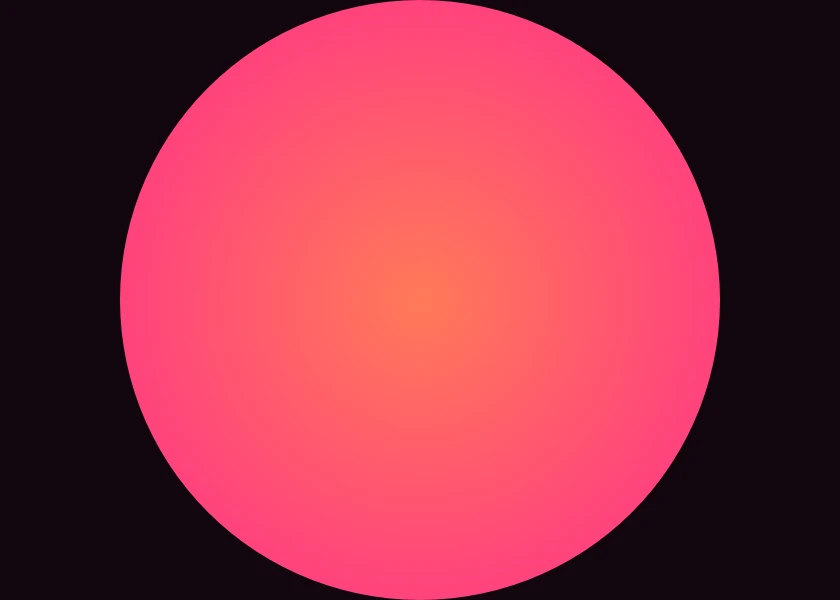
InteractiveOne big soft shape that wobbles like set jelly wherever you poke it.
Backgrounds · SwiftUI · Flutter · iOS 17 · Flutter 3.27
- background
- blob
- jelly
- wobble
- organic
- interactive
- touch
The actual source
JellyBlob.swift
// Jelly Blob · syxUI · https://syxui.dev/components/jelly-blob
// Free in any project. Keep this line and credit syxUI where a person can read it.

import SwiftUI

/// One big soft shape that wobbles like set jelly wherever you poke it.
///
/// The wobble is a bank of damped angular oscillators — one per radial mode
/// `n = 2...modes+1` — each a real second-order simulation (position *and*
/// velocity), not a keyframe curve: a touch adds a velocity kick, and the
/// mode rings down on its own afterwards. Modes are stored as two coupled
/// real oscillators per `n` (a cos-basis and a sin-basis component) so kicks
/// from any angle compose additively with no per-tap buffer, and higher
/// modes are tuned to decay faster than the fundamental — that's what reads
/// as jelly rather than a cartoon boing.
///
/// `JellySim` is a plain, non-observed class held in `@State` and mutated
/// from inside the `Canvas` closure, per §0.2 of the backgrounds contract.
struct JellyBlob: View {
    var radius: CGFloat = 150
    var wobble: Double = 0.16
    var decay: Double = 0.75
    /// More modes reads stiffer.
    var modes: Int = 4
    var fill: [Color] = [
        Color(red: 1.0, green: 0.478, blue: 0.349),
        Color(red: 1.0, green: 0.239, blue: 0.506),
    ]
    var background: Color = Color(red: 0.071, green: 0.024, blue: 0.059)
    /// Preview override. When set, the wobble is evaluated as a closed-form
    /// impulse response instead of stepping the live oscillator bank — see
    /// `previewDeformation`.
    var phase: Double? = nil

    @Environment(\.accessibilityReduceMotion) private var reduceMotion
    @State private var animated: Double = 0
    @State private var sim = JellySim()
    @State private var heldTouch: CGPoint? = nil
    @State private var touchDownAt: CGPoint? = nil

    private var current: Double { phase ?? animated }
    private let sampleCount = 120
    // The breathing period this component describes (1.0 -> 1.03 over 5s) is
    // continuous ambient motion, not something that settles — `current`
    // cycles forever in the live case and samples one such cycle in preview.
    private let breathePeriod: Double = 5.0
    // Preview-only: the scripted poke's clock, independent of `breathePeriod`
    // so the closed-form ring-down has room to fully settle before the loop
    // wraps (see `previewDeformation`).
    private let previewPeriodSeconds: Double = 3.0
    private let previewPokeAt: Double = 0.04
    private let previewPokeTheta: Double = 0.35 * Double.pi

    var body: some View {
        GeometryReader { proxy in
            let centre = CGPoint(x: proxy.size.width / 2, y: proxy.size.height / 2)
            Canvas { context, size in
                context.fill(Path(CGRect(origin: .zero, size: size)), with: .color(background))

                if phase == nil, !reduceMotion {
                    sim.ensureCount(modes)
                    sim.step(now: .now, decay: decay)
                }

                let breathe = 1 + 0.03 * sin(2 * .pi * current)
                let canvasCentre = CGPoint(x: size.width / 2, y: size.height / 2)

                var path = Path()
                for step in 0..<sampleCount {
                    let theta = 2 * .pi * Double(step) / Double(sampleCount)
                    let deformation: Double
                    if phase == nil {
                        deformation = sim.deformation(theta: theta) + heldBump(theta: theta, centre: canvasCentre)
                    } else {
                        deformation = previewDeformation(theta: theta, loopT: current)
                    }
                    let scale = max(0.5, min(1.6, 1 + deformation))
                    let r = radius * CGFloat(breathe * scale)
                    let point = CGPoint(x: canvasCentre.x + r * cos(theta), y: canvasCentre.y + r * sin(theta))
                    if step == 0 { path.move(to: point) } else { path.addLine(to: point) }
                }
                path.closeSubpath()

                let shading = GraphicsContext.Shading.radialGradient(
                    Gradient(colors: fill),
                    center: canvasCentre,
                    startRadius: 0,
                    endRadius: radius * 1.1
                )
                context.fill(path, with: shading)
            }
            .contentShape(Rectangle())
            .gesture(dragGesture(centre: centre))
        }
        .onAppear(perform: start)
        .accessibilityHidden(true)
    }

    // MARK: - Live held bump

    /// While a finger is down, the surface pulls toward it directly (not
    /// through the modal sim) so the drag reads as continuous; releasing
    /// hands this bump's angle and reach to the oscillator bank as one kick.
    private func heldBump(theta: Double, centre: CGPoint) -> Double {
        guard let touch = heldTouch else { return 0 }
        let dx = touch.x - centre.x
        let dy = touch.y - centre.y
        guard hypot(dx, dy) > 1 else { return 0 }
        let touchTheta = atan2(dy, dx)
        let diff = wrappedAngleDiff(theta - touchTheta)
        let sigma = 0.55
        let amount = 0.6 * wobble
        return amount * exp(-(diff * diff) / (2 * sigma * sigma))
    }

    // MARK: - Preview scripted poke (mechanism A — closed-form)

    /// The modes are a linear damped system, so a single scripted poke can be
    /// evaluated directly at `phase` with the exact impulse-response formula
    /// instead of integrating — no simulation needed for a deterministic
    /// preview frame.
    private func previewDeformation(theta: Double, loopT: Double) -> Double {
        let dt = (loopT - previewPokeAt) * previewPeriodSeconds
        guard dt > 0 else { return 0 }
        var sum = 0.0
        for index in 0..<max(modes, 0) {
            let n = Double(index + 2)
            let target = wobble / pow(2, Double(index))
            let omega = 2 * .pi * modeFrequency(index)
            let tau = modeTau(index, decay: decay)
            let zeta = min(1 / (tau * omega), 0.95)
            let omegaD = omega * (max(1 - zeta * zeta, 0.0001)).squareRoot()
            let v0 = target * omega
            let envelope = v0 / omegaD * exp(-zeta * omega * dt) * sin(omegaD * dt)
            sum += envelope * cos(n * (theta - previewPokeTheta))
        }
        return sum
    }

    // MARK: - Gesture

    private func dragGesture(centre: CGPoint) -> some Gesture {
        DragGesture(minimumDistance: 0)
            .onChanged { value in
                guard phase == nil, !reduceMotion else { return }
                if touchDownAt == nil {
                    touchDownAt = value.location
                    let dx = value.location.x - centre.x
                    let dy = value.location.y - centre.y
                    let dist = hypot(dx, dy)
                    let theta = atan2(dy, dx)
                    // A poke near the middle does less; the rim gets the full kick.
                    let nearness = max(0.15, min(dist / radius, 1.0))
                    sim.excite(theta: theta, amount: nearness, wobble: wobble)
                }
                heldTouch = value.location
            }
            .onEnded { value in
                defer {
                    heldTouch = nil
                    touchDownAt = nil
                }
                guard phase == nil, !reduceMotion, let start = touchDownAt else { return }
                let dx = value.location.x - centre.x
                let dy = value.location.y - centre.y
                let theta = atan2(dy, dx)
                let dragDistance = hypot(value.location.x - start.x, value.location.y - start.y)
                let amount = min(dragDistance / radius, 1.0)
                guard amount > 0.02 else { return }
                sim.excite(theta: theta, amount: amount, wobble: wobble)
            }
    }

    private func start() {
        guard phase == nil, !reduceMotion else { return }
        withAnimation(.linear(duration: breathePeriod).repeatForever(autoreverses: false)) {
            animated = 1
        }
    }
}

private func wrappedAngleDiff(_ angle: Double) -> Double {
    atan2(sin(angle), cos(angle))
}

/// Mode `index` (0-based) is angular order `n = index + 2`. Frequencies climb
/// roughly 0.8Hz per mode and decay times shrink per mode — the higher modes
/// die first, which is what makes this read as jelly rather than rubber.
private func modeFrequency(_ index: Int) -> Double { 2.1 + 0.8 * Double(index) }
private func modeTau(_ index: Int, decay: Double) -> Double { decay * max(0.35, 1 - 0.15 * Double(index)) }

/// A plain, non-observed class holding the modal oscillator bank. Nothing
/// here is `@Observable` — it is mutated directly from inside the `Canvas`
/// closure per the contract's stateful-simulation pattern.
private final class JellySim {
    struct Mode {
        var x: Double = 0
        var vx: Double = 0
        var y: Double = 0
        var vy: Double = 0
    }

    private(set) var modes: [Mode] = []
    private var lastStep: Date?

    func ensureCount(_ count: Int) {
        let clamped = max(count, 0)
        guard modes.count != clamped else { return }
        modes = Array(repeating: Mode(), count: clamped)
    }

    /// Impulse-excite every mode from a touch at `theta`. Each mode carries a
    /// cos-basis and sin-basis oscillator so the kick's direction is captured
    /// without needing to remember which angle excited it — a second kick
    /// from a different angle simply adds into the same two scalars.
    func excite(theta: Double, amount: Double, wobble: Double) {
        for index in modes.indices {
            let n = Double(index + 2)
            let target = wobble / pow(2, Double(index))
            let omega = 2 * .pi * modeFrequency(index)
            let kick = target * amount * omega
            modes[index].vx += kick * cos(n * theta)
            modes[index].vy += kick * sin(n * theta)
        }
    }

    /// Fixed-dt catch-up loop, clamped to a few substeps so a background/
    /// foreground round-trip cannot make the ring-down jump.
    func step(now: Date, decay: Double) {
        let dt = 1.0 / 60
        let elapsed = lastStep.map { now.timeIntervalSince($0) } ?? dt
        lastStep = now
        let steps = max(1, min(Int((elapsed / dt).rounded()), 4))

        for _ in 0..<steps {
            for index in modes.indices {
                let omega = 2 * .pi * modeFrequency(index)
                let zeta = min(1 / (modeTau(index, decay: decay) * omega), 0.95)
                // Copied out and written back so each `advance` holds one
                // exclusive access to `modes`. Passing two fields of the same
                // element as `inout` in one call is an overlapping access and
                // does not compile under optimisation.
                var mode = modes[index]
                advance(&mode.x, &mode.vx, omega: omega, zeta: zeta, dt: dt)
                advance(&mode.y, &mode.vy, omega: omega, zeta: zeta, dt: dt)
                modes[index] = mode
            }
        }
    }

    private func advance(_ x: inout Double, _ v: inout Double, omega: Double, zeta: Double, dt: Double) {
        let acceleration = -omega * omega * x - 2 * zeta * omega * v
        v += acceleration * dt
        x += v * dt
    }

    func deformation(theta: Double) -> Double {
        var sum = 0.0
        for (index, mode) in modes.enumerated() {
            let n = Double(index + 2)
            sum += mode.x * cos(n * theta) + mode.y * sin(n * theta)
        }
        return sum
    }
}

#Preview {
    JellyBlob()
        .frame(width: 420, height: 300)
}
iOS 17 · No dependencies
SwiftUI note. One filled path of 120 samples per frame — the cheapest, most resolution-independent effect in the set. The 1.0 -> 1.03 breathing never stops, so unlike `pluck-threads` this canvas always redraws; that stays cheap because it's a single path fill, not a full-screen pass. With `phase` set, the wobble is evaluated as a closed-form impulse response at one scripted poke rather than stepped, so the preview needs no simulation at all.
Dependencies
- SwiftUI
- No external dependencies
- Flutter
- No external dependencies
Requires iOS 17
Requires Flutter 3.27