Ticket Tear
From syxUI — written for both platforms, not translated between them.
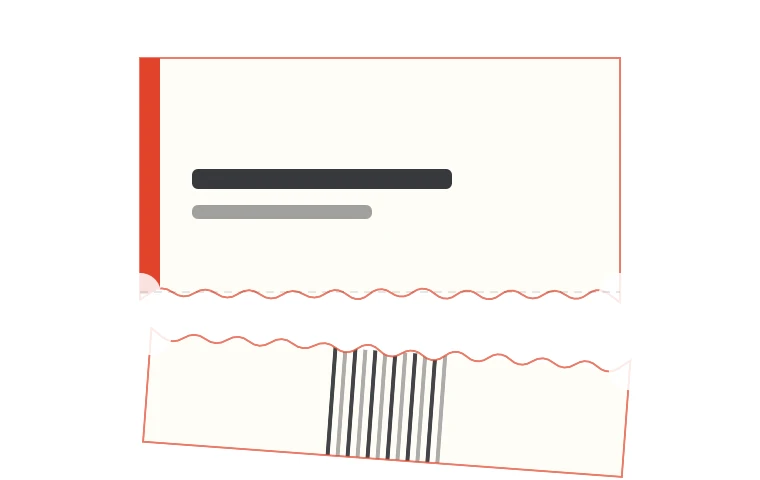
InteractiveA perforated ticket whose stub tears away, the rip growing teeth as it separates.
Cards · SwiftUI · Flutter · iOS 17 · Flutter 3.27
- card
- ticket
- receipt
- tear
- perforation
- shape
- morph
- coupon
The actual source
MorphTicketTear.swift
// Ticket Tear · syxUI · https://syxui.dev/components/morph-ticket-tear
// Free in any project. Keep this line and credit syxUI where a person can read it.

import SwiftUI

/// A perforated ticket whose stub tears away, the rip growing teeth as it
/// separates.
///
/// The only thing that lives in the `Shape`'s `animatableData` is the tear
/// amplitude — that is what must be continuous in the parameter, not
/// crossfaded, or the fibrous edge would pop in rather than grow. The stub's
/// rotation, its drift offset, and the notch radius are ordinary values
/// derived straight from `progress`, since none of them need a `Shape` to
/// interpolate correctly.
struct MorphTicketTear: View {
    var paperColor: Color = Color(red: 1.0, green: 0.992, blue: 0.969)
    var inkColor: Color = Color(red: 0.078, green: 0.086, blue: 0.110)
    var accent: Color = Color(red: 0.878, green: 0.267, blue: 0.169)

    /// Tear amplitude at full separation. 0 keeps the perforation a flat line.
    var amplitude: Double = 7
    var teeth: Int = 22
    /// Notch radius while attached. Grows by 2pt as the ticket opens.
    var notchRadius: Double = 9

    /// Preview override. When set, this renders that point of one tear
    /// instead of waiting for a tap.
    var progress: Double? = nil

    @Environment(\.accessibilityReduceMotion) private var reduceMotion
    @State private var interactive: Double = 0

    private var p: Double { progress ?? interactive }

    private static let width: CGFloat = 240
    private static let mainHeight: CGFloat = 118
    private static let stubHeight: CGFloat = 54

    var body: some View {
        let currentAmplitude = CGFloat(amplitude * p)
        let currentRadius = CGFloat(notchRadius + 2 * p)

        VStack(spacing: 10) {
            piece(
                content: mainContent,
                width: Self.width,
                height: Self.mainHeight,
                amplitude: currentAmplitude,
                flipped: false,
                radius: currentRadius
            )
            .overlay(alignment: .bottom) { dashedGuide }

            piece(
                content: stubContent,
                width: Self.width,
                height: Self.stubHeight,
                amplitude: currentAmplitude,
                flipped: true,
                radius: currentRadius
            )
            .rotationEffect(.degrees(6 * p), anchor: .topLeading)
            .offset(x: 8 * p, y: 14 * p)
        }
        .frame(maxWidth: .infinity, maxHeight: .infinity)
        .contentShape(Rectangle())
        .onTapGesture(perform: toggle)
        .accessibilityElement()
        .accessibilityAddTraits(.isButton)
        .accessibilityLabel("Ticket stub")
        .accessibilityValue(p > 0.5 ? "Torn away" : "Attached")
        .accessibilityHint("Tears the stub away, or rejoins it")
    }

    /// One half of the ticket: its fill and the 1pt rip highlight share the
    /// same jagged outline, and the perforation notches are punched through
    /// both with `.destinationOut` rather than painted on top, so whatever
    /// sits behind the ticket actually shows through the holes.
    private func piece(
        content: some View,
        width: CGFloat,
        height: CGFloat,
        amplitude: CGFloat,
        flipped: Bool,
        radius: CGFloat
    ) -> some View {
        let edge = TicketTornEdge(amplitude: amplitude, teeth: teeth, flipped: flipped)
        return ZStack {
            content
                .frame(width: width, height: height)
                .clipShape(edge)
            edge
                .stroke(accent.opacity(p), lineWidth: 1)
            notches(radius: radius, width: width, height: height, atBottom: !flipped)
        }
        .compositingGroup()
        .frame(width: width, height: height)
    }

    private func notches(radius: CGFloat, width: CGFloat, height: CGFloat, atBottom: Bool) -> some View {
        let y = atBottom ? height : 0
        return ZStack {
            Circle().frame(width: radius * 2, height: radius * 2).position(x: 0, y: y)
            Circle().frame(width: radius * 2, height: radius * 2).position(x: width, y: y)
        }
        .blendMode(.destinationOut)
    }

    private var mainContent: some View {
        ZStack(alignment: .leading) {
            Rectangle().fill(paperColor)
            Rectangle().fill(accent).frame(width: 10)
            VStack(alignment: .leading, spacing: 8) {
                RoundedRectangle(cornerRadius: 3).fill(inkColor.opacity(0.85)).frame(width: 130, height: 10)
                RoundedRectangle(cornerRadius: 3).fill(inkColor.opacity(0.4)).frame(width: 90, height: 7)
            }
            .padding(.leading, 26)
            .padding(.top, 18)
        }
    }

    private var stubContent: some View {
        ZStack {
            Rectangle().fill(paperColor)
            HStack(spacing: 3) {
                ForEach(0..<12, id: \.self) { index in
                    Rectangle()
                        .fill(inkColor.opacity(index.isMultiple(of: 2) ? 0.8 : 0.35))
                        .frame(width: 2)
                }
            }
            .padding(.horizontal, 24)
        }
    }

    private var dashedGuide: some View {
        Path { path in
            path.move(to: CGPoint(x: 0, y: 0))
            path.addLine(to: CGPoint(x: Self.width, y: 0))
        }
        .stroke(inkColor.opacity(0.35 * (1 - p)), style: StrokeStyle(lineWidth: 1, dash: [4, 3]))
        .frame(width: Self.width, height: 1)
    }

    private func toggle() {
        guard progress == nil else { return }
        let target = p > 0.5 ? 0.0 : 1.0
        if reduceMotion {
            interactive = target
        } else {
            withAnimation(.spring(response: 0.50, dampingFraction: 0.70)) {
                interactive = target
            }
        }
    }
}

/// The jagged perforation edge shared by both halves of the ticket.
///
/// Only `amplitude` interpolates — at 0 the edge is exactly a straight line
/// (a whole, unteared ticket), and it grows into a fibrous rip without ever
/// swapping to a different path. Teeth are smoothed through with
/// `addQuadCurve` so the edge reads as torn paper rather than a saw blade.
private struct TicketTornEdge: Shape {
    var amplitude: CGFloat
    var teeth: Int
    var flipped: Bool

    var animatableData: CGFloat {
        get { amplitude }
        set { amplitude = newValue }
    }

    func path(in rect: CGRect) -> Path {
        let count = max(teeth, 2)
        // The jagged edge sits at the ticket's own bottom for the main body,
        // or its own top for the stub — the two halves' perforations meet at
        // that shared line before they separate.
        let baseline: CGFloat = flipped ? rect.minY : rect.maxY

        var points: [CGPoint] = []
        points.reserveCapacity(count + 1)
        for i in 0...count {
            let x = rect.minX + rect.width * CGFloat(i) / CGFloat(count)
            let sign: CGFloat = i.isMultiple(of: 2) ? 1 : -1
            let jitter = 0.6 + 0.4 * Self.hash(i)
            let toothDepth = amplitude * jitter * sign
            // Teeth point away from the piece's own body on both halves, so
            // the two edges read as complementary fibres, not mirrors.
            let y = baseline + (flipped ? -toothDepth : toothDepth)
            points.append(CGPoint(x: x, y: y))
        }

        var path = Path()
        if flipped {
            path.move(to: CGPoint(x: rect.minX, y: rect.maxY))
            path.addLine(to: CGPoint(x: rect.minX, y: points[0].y))
            Self.addSmoothedEdge(&path, points: points)
            path.addLine(to: CGPoint(x: rect.maxX, y: rect.maxY))
        } else {
            path.move(to: CGPoint(x: rect.minX, y: rect.minY))
            path.addLine(to: CGPoint(x: rect.maxX, y: rect.minY))
            path.addLine(to: CGPoint(x: rect.maxX, y: points[count].y))
            Self.addSmoothedEdge(&path, points: points.reversed())
        }
        path.closeSubpath()
        return path
    }

    /// Runs a quadratic curve through the midpoints of each consecutive
    /// pair, using the original vertex as the pull-toward control point —
    /// the standard way to round a zigzag into a fibrous curve without
    /// losing its overall shape.
    private static func addSmoothedEdge(_ path: inout Path, points: [CGPoint]) {
        guard points.count > 1 else { return }
        var previous = points[0]
        for index in 1..<points.count {
            let current = points[index]
            let mid = CGPoint(x: (previous.x + current.x) / 2, y: (previous.y + current.y) / 2)
            path.addQuadCurve(to: mid, control: previous)
            previous = current
        }
        path.addLine(to: points[points.count - 1])
    }

    /// Deterministic per-tooth pseudo-random in 0...1. `Double.random` would
    /// reshuffle the tear on every single frame instead of animating it.
    private static func hash(_ i: Int) -> Double {
        let x = sin(Double(i) * 12.9898) * 43758.5453
        return x - floor(x)
    }
}

#Preview {
    MorphTicketTear()
        .frame(width: 380, height: 240)
        .padding(24)
}
iOS 17 · No dependencies
SwiftUI note. The notches are punched with `.compositingGroup()` plus `.destinationOut`, so they show whatever sits behind the ticket rather than a painted circle. Keep something other than the default background behind it or the holes are invisible.
Dependencies
- SwiftUI
- No external dependencies
- Flutter
- No external dependencies
Requires iOS 17
Requires Flutter 3.27