Build State
From syxUI — written for both platforms, not translated between them.
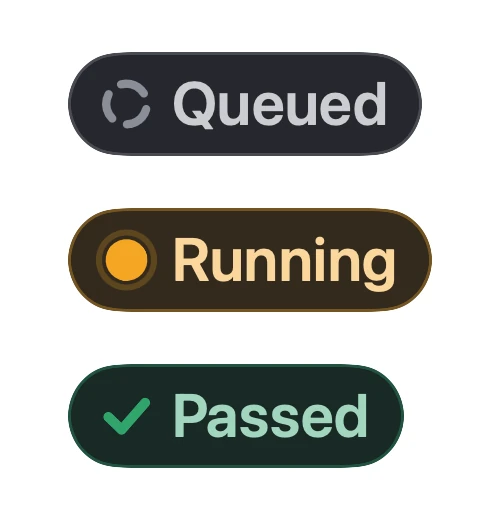
A CI badge cycling queued, running, and passed, with a calm live dot and a width that follows.
Badges · SwiftUI · Flutter · iOS 17 · Flutter 3.27
- badge
- status
- ci
- build
- pill
- live
- state
The actual source
BuildStateBadge.swift
// Build State · syxUI · https://syxui.dev/components/build-state-badge
// Free in any project. Keep this line and credit syxUI where a person can read it.

import SwiftUI

#if canImport(UIKit)
import UIKit
private typealias BuildBadgeFont = UIFont
#else
import AppKit
private typealias BuildBadgeFont = NSFont
#endif

/// Dashes in the queued ring. Three reads as "waiting" at 20pt; six reads as a
/// texture.
private let buildDashes = 3

/// Whole dash pitches the queued ring turns per cycle. Two is 0.67 of a turn in
/// a 6 s loop — a full revolution every 9 s, near enough the 8 s the design
/// asks for. It has to be a whole multiple of the dash pitch: anything else
/// leaves the ring a few degrees out of place at the loop's seam, and the badge
/// visibly jumps once per cycle.
private let buildDashTurns = 2.0

/// The loop, as fractions of `period`. Calibrated so that at the default
/// `period: 6` they land on the milliseconds each stage was designed in:
/// a 1.3 s wait, a 0.36 s morph, 2.5 s of running, 0.36 s to settle, 0.76 s
/// green, and a 0.72 s reset. Every sub-timing below is a fraction too, so the
/// slider scales the whole cycle without changing any relationship inside it.
private let buildMorph = 0.06 // 0.36 s
private let buildReset = 0.12 // 0.72 s — twice a morph, because it undoes two
private let buildQueuedHold = 0.216_667 // 1.30 s
private let buildRunHold = 0.416_667 // 2.50 s — exactly two breaths
private let buildPassHold = 0.126_667 // 0.76 s

// Boundaries, named once so the reader can follow the drive without arithmetic.
private let buildRunMorph = buildQueuedHold // 0.2167
private let buildRunStart = buildRunMorph + buildMorph // 0.2767
private let buildEndMorph = buildRunStart + buildRunHold // 0.6933
private let buildEndStart = buildEndMorph + buildMorph // 0.7533
private let buildResetAt = buildEndStart + buildPassHold // 0.8800

/// Where the colour finishes, as a fraction of the morph it belongs to.
///
/// This is the whole reason the colour is a separate track. Slate → amber and
/// amber → green both pass through a muddy midpoint — half green, half amber is
/// olive — so the colour is given 72% of the shape's window and an ease whose
/// speed *peaks* at the midpoint. It arrives while the mark is still moving:
/// the colour announces the state, the shape confirms it. Run them on one
/// timing and the badge sits in olive for the whole morph.
private let buildColourTrack = 0.72

/// The label rolls over between 18% and 36% of the morph — ahead of the colour,
/// which finishes at 72%, and well ahead of the shape, which finishes last.
/// Word, then colour, then mark.
///
/// All three of those numbers came out of rendered frames rather than out of
/// code, and each fixed something the code could not show:
///
/// - The alphas are **complements**, so they always sum to 1. Sequencing them
///   out-then-in leaves a window where neither is drawn, and that window lands
///   on the beat where the dot has collapsed and the check has not started, so
///   the pill emptied for about 70 ms twice a cycle.
/// - The window carries a **counter-roll** of a third of the height, so the two
///   words pass each other rather than blending. Two different words at half
///   opacity on one baseline reads as a double exposure.
/// - It **starts at 18%, not at 0**. Swapped any earlier the badge said
///   "Running" in slate with the dashed ring still open, which reads for two
///   frames as a mislabelled badge rather than as an early announcement.
private let buildLabelStart = 0.18
private let buildLabelSpan = 0.18
private let buildLabelRoll = 0.34

/// A build badge that cycles queued → running → passed as one lerped view.
///
/// The indicator is a single `Shape` whose `animatableData` is
/// `AnimatablePair(ringClose, tickDraw)`: a dashed slate ring closes into a
/// filled dot, the dot collapses to nothing, and a check draws out of the point
/// it vanished at. One path throughout — three icons crossfading is the thing
/// this replaces, and at 22pt a crossfade reads as a double exposure.
///
/// `PhaseAnimator` is the obvious tool and the wrong one: it cannot be pinned
/// to a `Double`, so the badge could never be rendered at a chosen frame, and a
/// component with no still is a component nobody clicks. Instead the whole
/// cycle is a pure function of one number and `phase` overrides it.
///
/// Four tracks, deliberately out of step, and that is the component: the
/// **label** has rolled over by 36% of the morph, the **colour** lands at 72%,
/// the **shape** finishes last, and the **width** runs
/// `Spring(response:dampingRatio:)` in real seconds rather than in fractions of
/// the loop — so the pill's trailing edge is still settling after the mark has
/// arrived. `pillWidth` goes on the badge's own frame, so a sibling in the row
/// slides on that spring instead of jumping when it ends. `AnimatedSize` and a
/// bare `.animation(_:value:)` on the frame both take a curve, and a
/// curve-driven width beside a spring-driven glyph is what reads as broken.
struct BuildStateBadge: View {
    /// Which way the build ends. `.failed` draws a cross — two strokes, the
    /// second 60 ms behind the first — and shakes 3pt when it lands.
    enum Outcome { case passed, failed }

    var height: CGFloat = 22
    /// Seconds for one queued → running → passed → queued cycle.
    var period: Double = 6
    var outcome: Outcome = .passed
    var queued: Color = Color(red: 0.545, green: 0.553, blue: 0.596)
    var running: Color = Color(red: 0.961, green: 0.647, blue: 0.141)
    var passed: Color = Color(red: 0.188, green: 0.643, blue: 0.424)

    /// Preview override. When set, the badge renders that point of one cycle
    /// instead of driving its own clock. 0 is queued, 1 is queued again.
    var phase: Double? = nil

    /// The width spring, as plain stored properties so the drive can be retuned
    /// from the call site rather than by editing this file. Written inline
    /// inside `Spring(...)` neither of these could be reached at all.
    ///
    /// Damped to 0.85 on purpose: the pill's edge is 8pt from a neighbour's
    /// leading edge, and a width that visibly wobbles past its target reads as
    /// a layout bug rather than as a spring.
    var widthResponse: Double = 0.32
    var widthDamping: Double = 0.85

    // Chosen, not exposed. The track is one colour for all four states so the
    // state colour is the only thing that moves; the label is that same colour
    // lifted toward white, which is what keeps it readable on the track at
    // every state instead of only on the dark ones.
    private let track = Color(red: 0.086, green: 0.094, blue: 0.114)
    private let failedTint = Color(red: 0.898, green: 0.267, blue: 0.243)

    @Environment(\.self) private var env
    @Environment(\.accessibilityReduceMotion) private var reduceMotion

    // The live clock, and a spring that a tap adds to it. Keeping them separate
    // is what makes a tap mid-transition retarget: the spring is re-launched
    // from its own current value *and velocity*, so a fast triple-tap slides
    // through the palette in one motion instead of queueing three.
    @State private var epoch = Date()
    @State private var skipFrom: Double = 0
    @State private var skipTo: Double = 0
    @State private var skipVelocity: Double = 0
    @State private var skipAt: Date? = nil
    @State private var struck: Int = -1

    var body: some View {
        Group {
            if let phase {
                pill(at: frame(at: phase))
            } else if reduceMotion {
                // A live indicator pinned at its zero crossing looks switched
                // off, so Reduce Motion lands on the frame that carries the
                // meaning: settled, green, check drawn.
                pill(at: frame(at: buildEndStart + buildPassHold / 2))
            } else {
                TimelineView(.animation) { timeline in
                    pill(at: frame(at: drive(at: timeline.date)))
                }
            }
        }
        .sensoryFeedback(trigger: struck) { _, step in
            // Nothing on queued: waiting should not buzz.
            switch step {
            case 1: return .impact(weight: .light)
            case 2: return .success
            case 3: return .error
            default: return nil
            }
        }
    }

    // MARK: - One frame

    @ViewBuilder
    private func pill(at frame: BuildBadgeFrame) -> some View {
        let mark = height * 0.48
        let radius = mark / 2
        let markCentre = CGPoint(x: height * 0.32 + radius, y: height / 2)
        let tint = frame.fill
        let ink = lift(tint, toward: 0.55)

        ZStack(alignment: .topLeading) {
            Capsule(style: .continuous)
                .fill(blend(track.resolve(in: env), tint, 0.13))
            Capsule(style: .continuous)
                .strokeBorder(alpha(tint, 0.34), lineWidth: max(0.8, height * 0.028))

            // The shed ring. Clipped inside the pill rather than drawn outside
            // it: on a dark track a ring crossing the rim at a fifth of full
            // opacity reads as a clipping fault, not as an emanation, and it
            // never grows past 0.42 * height so the capsule never cuts it.
            if frame.shed > 0 {
                // Starts just outside the dot at its fullest breath, so it is
                // never born inside the thing it came off.
                let travel = radius * (0.95 + 0.80 * frame.shed)
                Circle()
                    .strokeBorder(
                        alpha(tint, 0.32 * pow(1 - frame.shed, 0.9) * min(1, frame.shed / 0.08)),
                        lineWidth: mark * 0.12
                    )
                    .frame(width: travel * 2, height: travel * 2)
                    .offset(x: markCentre.x - travel, y: markCentre.y - travel)
            }

            BuildMark(
                ringClose: frame.ringClose,
                tickDraw: frame.tickDraw,
                breath: frame.breath,
                spin: frame.spin,
                crossed: outcome == .failed
            )
            .fill(tint)
            .frame(width: mark, height: mark)
            .offset(x: markCentre.x - radius, y: markCentre.y - radius)

            label(frame.outLabel, ink: ink, mark: mark)
                .opacity(frame.outAlpha)
                .offset(y: frame.outLift)
            label(frame.inLabel, ink: ink, mark: mark)
                .opacity(frame.inAlpha)
                .offset(y: frame.inLift)
        }
        .frame(width: CGFloat(frame.width), height: height)
        .clipShape(Capsule(style: .continuous))
        .offset(x: frame.shake)
        .contentShape(Capsule(style: .continuous))
        .onTapGesture(perform: advance)
        .accessibilityElement()
        .accessibilityLabel(Text("Build status"))
        .accessibilityValue(Text(frame.spoken))
    }

    private func label(_ string: String, ink: Color.Resolved, mark: CGFloat) -> some View {
        Text(string)
            .font(.system(size: height * 0.58, weight: .semibold))
            .foregroundStyle(ink)
            .lineLimit(1)
            .fixedSize()
            .frame(height: height, alignment: .center)
            .offset(x: height * 0.32 + mark + height * 0.20, y: opticalNudge)
    }

    /// Text sits high in its line box, so a geometrically centred label reads
    /// low. This puts the midpoint between baseline and cap height on the
    /// pill's centre instead, computed from the font rather than guessed.
    private var opticalNudge: CGFloat {
        let font = platformFont
        return (font.capHeight - font.ascender - font.descender) / 2
    }

    // MARK: - Drive

    /// Unwrapped position on the cycle. The linear clock plus whatever a tap
    /// has added to it.
    private func drive(at date: Date) -> Double {
        date.timeIntervalSince(epoch) / max(0.5, period) + skipped(at: date)
    }

    private func skipped(at date: Date) -> Double {
        guard let skipAt else { return skipTo }
        return skipSpring.value(
            fromValue: skipFrom,
            toValue: skipTo,
            initialVelocity: skipVelocity,
            time: date.timeIntervalSince(skipAt)
        )
    }

    private var skipSpring: Spring { Spring(response: 0.42, dampingRatio: 1.0) }

    /// The whole visual state at one point of the cycle.
    ///
    /// Three morphs bracket the three holds, so any position resolves to "which
    /// morph was last, and how long ago". A hold is simply a morph whose `u`
    /// has reached 1 — which is what lets the width spring keep settling after
    /// the shape has arrived, rather than being cut off at the boundary.
    private func frame(at raw: Double) -> BuildBadgeFrame {
        let position = raw - raw.rounded(.down)
        let last = morph(before: position)
        let elapsed = (position - last.start + (position < last.start ? 1 : 0))
        let seconds = elapsed * max(0.5, period)
        let u = min(1, elapsed / last.span)

        let from = last.from, to = last.to
        let colour = smooth(min(1, u / buildColourTrack))
        let tint = blend(resolved(from), resolved(to), colour)

        // The mark as one number: 0 ring, 1 dot, 2 check. A lerp of *that*
        // gives the reverse sequence for free on the reset — check retracts,
        // dot re-forms, dot opens — which is why the cycle can close on itself
        // without a cut.
        let travelled = last.kind.shaped(u)
        let position2 = from.mark + (to.mark - from.mark) * travelled

        var breath = 1.0
        var shed = 0.0
        if position >= buildRunStart && position < buildEndMorph {
            let v = (position - buildRunStart) / buildRunHold
            // Two breaths in the window, so the dot is at rest at both ends and
            // the loop closes. The ring is shed off the *first* one only, which
            // is what stops the rhythm reading as a metronome.
            breath = 1 + 0.11 * (1 - cos(4 * .pi * v))
            if v > 0.22 && v < 0.50 { shed = (v - 0.22) / 0.28 }
        }

        var shake: CGFloat = 0
        if outcome == .failed, last.to == .failed {
            let s = (seconds - last.span * max(0.5, period)) / 0.42
            if s > 0 && s < 1 {
                shake = height * 0.136 * CGFloat(sin(4 * .pi * s) * (1 - s))
            }
        }

        let swap = smooth((u - buildLabelStart) / buildLabelSpan)

        return BuildBadgeFrame(
            width: Spring(response: widthResponse, dampingRatio: widthDamping)
                .value(
                    fromValue: pillWidth(from),
                    toValue: pillWidth(to),
                    initialVelocity: 0,
                    time: seconds
                ),
            fill: tint,
            ringClose: min(1, position2),
            tickDraw: max(0, position2 - 1),
            breath: breath,
            spin: position * buildDashTurns * 360 / Double(buildDashes),
            shed: shed,
            outLabel: from.label,
            outAlpha: 1 - swap,
            outLift: -height * buildLabelRoll * swap,
            inLabel: to.label,
            inAlpha: swap,
            inLift: height * buildLabelRoll * (1 - swap),
            shake: shake,
            spoken: (swap < 0.5 ? from : to).spoken
        )
    }

    /// The morph a position sits in or after, and the two states it brackets.
    private func morph(before position: Double) -> BuildBadgeMorph {
        let ending: BuildBadgeStep = outcome == .failed ? .failed : .passed
        if position >= buildRunMorph && position < buildEndMorph {
            return .init(start: buildRunMorph, span: buildMorph, from: .queued, to: .running, kind: .close)
        }
        if position >= buildEndMorph && position < buildResetAt {
            return .init(start: buildEndMorph, span: buildMorph, from: .running, to: ending, kind: .draw)
        }
        return .init(start: buildResetAt, span: buildReset, from: ending, to: .queued, kind: .rewind)
    }

    /// Jump to the next state.
    ///
    /// The tap moves the *clock*, not a separate state machine, so every
    /// re-timing above applies to a tapped transition exactly as it does to an
    /// automatic one. Landing 2% inside the next hold rather than at its middle
    /// leaves room for the linear clock, which keeps running underneath while
    /// the spring travels.
    private func advance() {
        guard phase == nil, !reduceMotion else { return }
        let now = Date()
        let here = drive(at: now)
        let position = here - here.rounded(.down)
        let gates = [0.0, buildRunStart, buildEndStart].map { $0 + 0.02 }
        let index = gates.firstIndex { $0 > position + 0.01 } ?? 0
        var delta = gates[index] - position
        if delta <= 0 { delta += 1 }

        skipFrom = skipped(at: now)
        skipVelocity = skipAt.map { at in
            skipSpring.velocity(
                fromValue: skipFrom,
                toValue: skipTo,
                initialVelocity: skipVelocity,
                time: now.timeIntervalSince(at)
            )
        } ?? 0
        skipTo = skipFrom + delta
        skipAt = now

        // Struck at the tap, not on arrival: feedback that trails the finger by
        // the spring's 0.42 s reads as lag, and the tap is what the hand did.
        switch index {
        case 1: struck = 1
        case 2: struck = outcome == .failed ? 3 : 2
        default: struck = 0
        }
    }

    // MARK: - Geometry and colour

    private func resolved(_ step: BuildBadgeStep) -> Color.Resolved {
        switch step {
        case .queued: return queued.resolve(in: env)
        case .running: return running.resolve(in: env)
        case .passed: return passed.resolve(in: env)
        case .failed: return failedTint.resolve(in: env)
        }
    }

    /// The pill is its label plus fixed chrome, measured rather than guessed.
    ///
    /// `NSString.size(withAttributes:)` is exact for the descriptor `Text` draws
    /// with, and synchronous, which is what the Flutter side gets from
    /// `TextPainter`. At 22pt tall that is 77.5 / 80.1 / 73.8 / 65.9 points for
    /// the four words — so the row *opens* 2.6pt into running and *closes* 6.2pt
    /// into passed, or 14.1pt into failed. The contraction is the interesting
    /// half: a list of builds tightens as they finish.
    private func pillWidth(_ step: BuildBadgeStep) -> Double {
        let text = (step.label as NSString)
            .size(withAttributes: [.font: platformFont]).width
        return Double(text + height * 0.32 * 2 + height * 0.48 + height * 0.20)
    }

    private var platformFont: BuildBadgeFont {
        .systemFont(ofSize: height * 0.58, weight: .semibold)
    }
}

// MARK: - The indicator

/// Ring → dot → check as one filled path.
///
/// `ringClose` closes a dashed annulus into a solid dot: the gaps shut first,
/// then the hole. `tickDraw` spends its first third collapsing that dot — the
/// anticipation before the result — and its remaining two thirds drawing the
/// mark out of the point the dot vanished at, short leg first. At the handover
/// both are zero-sized, which is why there is never a frame with two shapes in
/// it.
///
/// The path is *filled*, not stroked, because the ring's own thickness has to
/// animate and a `StrokeStyle` interpolates between endpoint widths instead of
/// being evaluated per frame. `strokedPath` turns the tick's centreline into a
/// fillable outline, so one `fill` covers every state.
private struct BuildMark: Shape {
    var ringClose: Double
    var tickDraw: Double
    /// Not part of `animatableData`: the whole badge body is re-evaluated every
    /// frame from one drive, so this arrives already correct and has nothing to
    /// interpolate.
    var breath: Double
    var spin: Double
    var crossed: Bool

    var animatableData: AnimatablePair<Double, Double> {
        get { AnimatablePair(ringClose, tickDraw) }
        set {
            ringClose = newValue.first
            tickDraw = newValue.second
        }
    }

    func path(in rect: CGRect) -> Path {
        let side = min(rect.width, rect.height)
        let centre = CGPoint(x: rect.midX, y: rect.midY)
        let radius = side / 2
        let stroke = radius * 0.34
        let close = min(max(ringClose, 0), 1)
        let draw = min(max(tickDraw, 0), 1)

        // First third of `tickDraw` is the dot's collapse, eased in so it
        // gathers speed as it goes; the rest is the mark drawing.
        let collapse = min(1, draw * 3)
        let drawn = ease(max(0, (draw - 1.0 / 3) / (2.0 / 3)))

        if drawn > 0.001 {
            return tick(side: side, origin: rect.origin, stroke: stroke, drawn: drawn)
        }

        // The dot drifts toward the point the mark starts from as it shrinks,
        // so the check appears to be pulled out of what is left of it.
        let target = crossed
            ? CGPoint(x: 0.5, y: 0.5)
            : CGPoint(x: 0.13, y: 0.53)
        let pull = collapse * collapse
        let hub = CGPoint(
            x: centre.x + (rect.minX + target.x * side - centre.x) * pull,
            y: centre.y + (rect.minY + target.y * side - centre.y) * pull
        )

        let grown = 1 + (breath - 1) * close
        let outer = radius * (1 - 0.28 * close) * grown * (1 - collapse)
        let inner = max(0, (outer - stroke * (1 - collapse)) * (1 - close))
        guard outer > 0.01 else { return Path() }

        // Each dash is an arc centreline stroked to the annulus's own thickness
        // with round caps, so the gaps have soft ends rather than radial saw
        // cuts. It also degenerates correctly: at `close == 1` the inner radius
        // is zero, so the centreline sits at half the outer radius and the
        // stroke is the full diameter — a solid dot, out of the same expression.
        //
        // The gaps shut by the time the ring is half closed. Three abutting
        // stroked arcs union under a non-zero fill, so no seam can appear at
        // the moment they meet.
        let filled = smooth(min(1, close / 0.5))
        let pitch = 360.0 / Double(buildDashes)
        let span = pitch * (0.62 + 0.38 * filled)
        let mid = (outer + inner) / 2
        let style = StrokeStyle(lineWidth: outer - inner, lineCap: .round)

        var path = Path()
        for index in 0..<buildDashes {
            let start = spin + Double(index) * pitch
            var dash = Path()
            dash.addArc(
                center: hub,
                radius: mid,
                startAngle: .degrees(start),
                endAngle: .degrees(start + span),
                clockwise: false
            )
            path.addPath(dash.strokedPath(style))
        }
        return path
    }

    /// A check, or a cross whose second stroke is 60 ms behind the first —
    /// a quarter of the 240 ms draw, which is what makes a failure read as two
    /// deliberate strokes rather than an X stamped on.
    private func tick(side: CGFloat, origin: CGPoint, stroke: CGFloat, drawn: Double) -> Path {
        // A shade heavier than the ring's own thickness: a check is a thin
        // diagonal where the ring was a closed curve, and matched stroke for
        // stroke it reads lighter than the dot it replaced.
        let style = StrokeStyle(lineWidth: stroke * 1.18, lineCap: .round, lineJoin: .round)
        func at(_ x: CGFloat, _ y: CGFloat) -> CGPoint {
            CGPoint(x: origin.x + x * side, y: origin.y + y * side)
        }

        var path = Path()
        if crossed {
            var first = Path()
            first.move(to: at(0.22, 0.22))
            first.addLine(to: at(0.78, 0.78))
            path.addPath(first.trimmedPath(from: 0, to: min(1, drawn / 0.75))
                .strokedPath(style))

            let second = min(1, max(0, (drawn - 0.25) / 0.75))
            if second > 0.001 {
                var line = Path()
                line.move(to: at(0.78, 0.22))
                line.addLine(to: at(0.22, 0.78))
                path.addPath(line.trimmedPath(from: 0, to: second).strokedPath(style))
            }
            return path
        }

        // Short leg first: it is 34% of the polyline's length, so the trim
        // draws it in the first third of the window without being told to.
        var line = Path()
        line.move(to: at(0.13, 0.53))
        line.addLine(to: at(0.40, 0.79))
        line.addLine(to: at(0.88, 0.24))
        path.addPath(line.trimmedPath(from: 0, to: drawn).strokedPath(style))
        return path
    }
}

// MARK: - Model

private enum BuildBadgeStep {
    case queued, running, passed, failed

    /// 0 ring, 1 dot, 2 mark. One number, so a lerp between any two states
    /// walks the indicator through the shapes in between in the right order.
    var mark: Double {
        switch self {
        case .queued: return 0
        case .running: return 1
        case .passed, .failed: return 2
        }
    }

    var label: String {
        switch self {
        case .queued: return "Queued"
        case .running: return "Running"
        case .passed: return "Passed"
        case .failed: return "Failed"
        }
    }

    /// What VoiceOver says as the badge's value. Derived, so the spoken state
    /// and the drawn one cannot drift apart.
    var spoken: String { label.lowercased() }
}

private enum BuildBadgeKind {
    /// Ring to dot: one eased move, nothing sequenced.
    case close
    /// Dot to mark: 120 ms of collapse, then 240 ms of drawing.
    case draw
    /// The loop's reset. The forward morph in reverse, half each — the only way
    /// the cycle gets back to queued without a cut.
    case rewind

    func shaped(_ u: Double) -> Double {
        switch self {
        case .close:
            return smooth(u)
        case .draw:
            if u <= 1.0 / 3 { return (1.0 / 3) * (3 * u) * (3 * u) }
            return 1.0 / 3 + (2.0 / 3) * ease((3 * u - 1) / 2)
        case .rewind:
            if u <= 0.5 { return 0.5 * smooth(2 * u) }
            return 0.5 + 0.5 * smooth(2 * u - 1)
        }
    }
}

private struct BuildBadgeMorph {
    var start: Double
    var span: Double
    var from: BuildBadgeStep
    var to: BuildBadgeStep
    var kind: BuildBadgeKind
}

private struct BuildBadgeFrame {
    var width: Double
    var fill: Color.Resolved
    var ringClose: Double
    var tickDraw: Double
    var breath: Double
    var spin: Double
    var shed: Double
    var outLabel: String
    var outAlpha: Double
    var outLift: CGFloat
    var inLabel: String
    var inAlpha: Double
    var inLift: CGFloat
    var shake: CGFloat
    var spoken: String
}

// MARK: - Curves and colour

private func smooth(_ t: Double) -> Double {
    let x = min(max(t, 0), 1)
    return x * x * (3 - 2 * x)
}

private func ease(_ t: Double) -> Double {
    let x = min(max(t, 0), 1)
    return 1 - (1 - x) * (1 - x)
}

/// Interpolated on the sRGB components, which is what `Color.lerp` does on the
/// Flutter side — so both files pass through the same midpoint.
private func blend(_ from: Color.Resolved, _ to: Color.Resolved, _ t: Double) -> Color.Resolved {
    let f = Float(min(max(t, 0), 1))
    return Color.Resolved(
        red: from.red + (to.red - from.red) * f,
        green: from.green + (to.green - from.green) * f,
        blue: from.blue + (to.blue - from.blue) * f,
        opacity: from.opacity + (to.opacity - from.opacity) * f
    )
}

private func lift(_ colour: Color.Resolved, toward white: Float) -> Color.Resolved {
    Color.Resolved(
        red: colour.red + (1 - colour.red) * white,
        green: colour.green + (1 - colour.green) * white,
        blue: colour.blue + (1 - colour.blue) * white,
        opacity: colour.opacity
    )
}

private func alpha(_ colour: Color.Resolved, _ value: Double) -> Color.Resolved {
    Color.Resolved(
        red: colour.red,
        green: colour.green,
        blue: colour.blue,
        opacity: Float(min(max(value, 0), 1))
    )
}

#Preview {
    // The first is live — tap it to jump to the next state.
    VStack(alignment: .leading, spacing: 18) {
        BuildStateBadge(height: 52)
        BuildStateBadge(height: 52, phase: 0.06)
        BuildStateBadge(height: 52, phase: 0.395)
        BuildStateBadge(height: 52, phase: 0.80)
        BuildStateBadge(height: 52, outcome: .failed, phase: 0.80)
    }
    .padding(24)
}
iOS 17 · No dependencies
SwiftUI note. The animated width sits on the badge's own frame, so a commit message dropped to its right closes in on the same spring as the build finishes. Each badge drives its own TimelineView(.animation); in a list of forty rows, hoist one timeline into the list and pass the phase down instead.
Dependencies
- SwiftUI
- No external dependencies
- Flutter
- No external dependencies
Requires iOS 17
Requires Flutter 3.27